
Underground Water Leak Detection: Don’t Dig Blind
Detection typically costs $200–$900.
Repairs may take 1–3 hours (shallow yard) or 1–2+ days (driveway or slab access).
Before breaking ground, confirm the leak, confirm the responsibility boundary, and confirm the right detection method.
Water surfacing in one location does not guarantee the rupture is directly beneath it. Pressurized water often travels along trench lines, compacted soil, or utility corridors before appearing at the surface.
Underground leak detection is about:
- Confirming continuous flow
- Identifying utility vs homeowner responsibility
- Narrowing the failure zone before excavation
- Preventing structural risk escalation
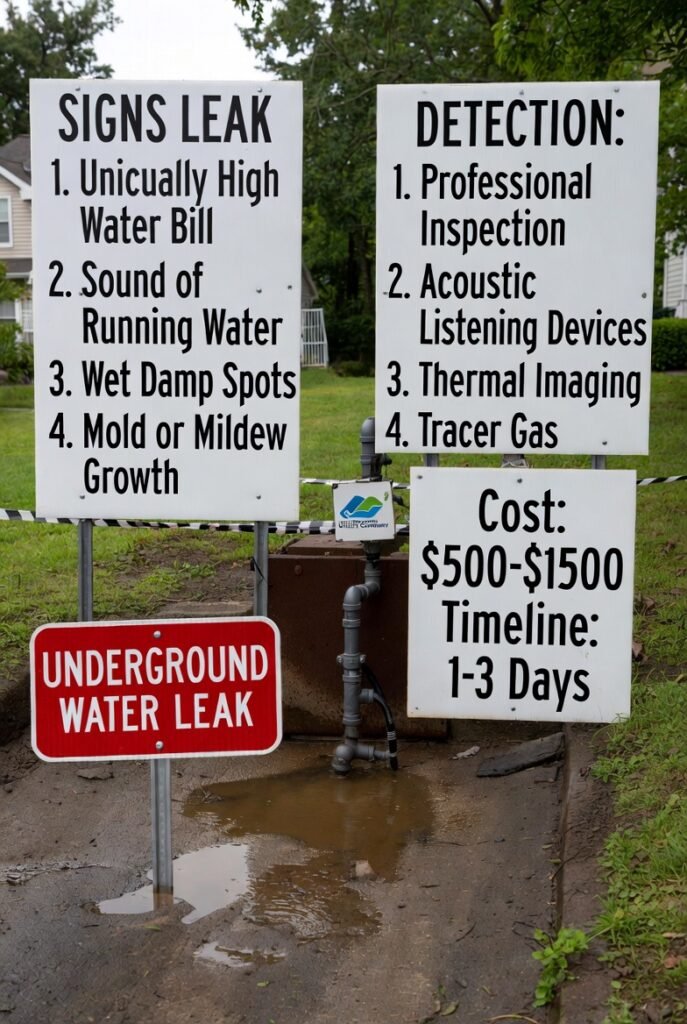
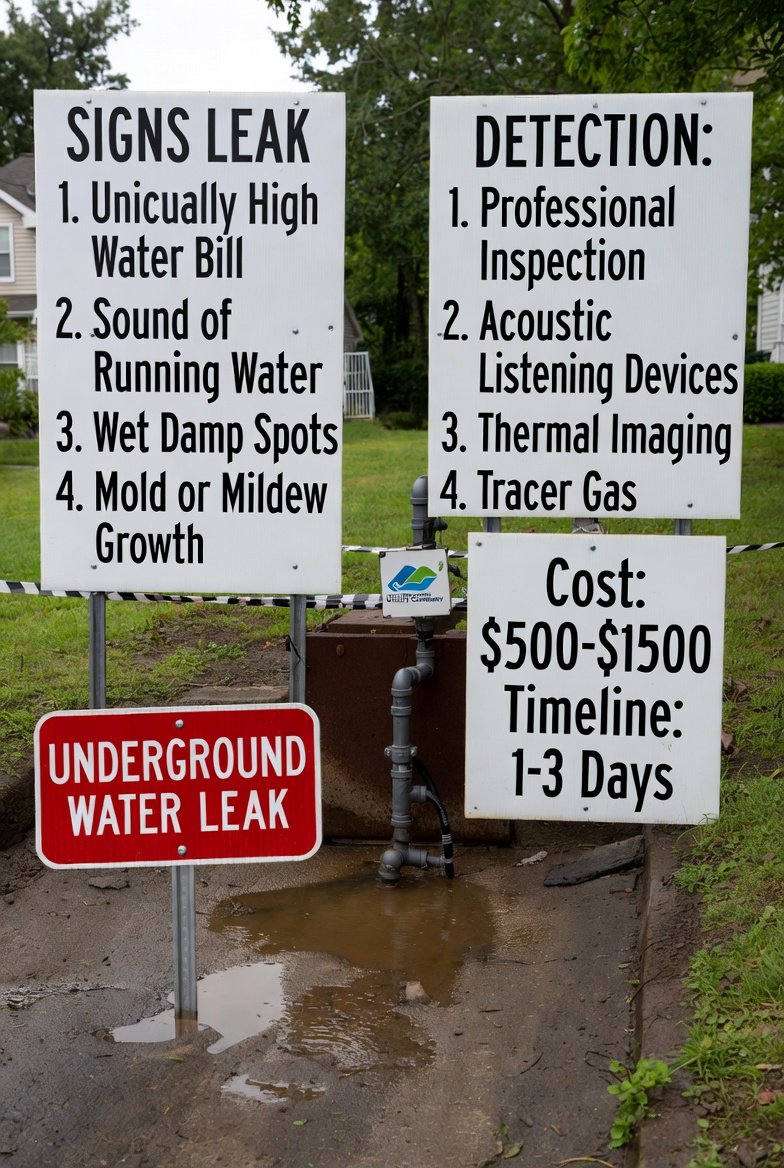
🔎 Signs of an Underground Water Leak
Look for these indicators:
- 💧 Sudden unexplained water bill increase
- 🔄 Continuous movement on the water meter
- 🌱 Unusually lush or soggy yard patch without rain
- ♨️ Warm driveway, slab, or flooring (hot line leak)
- 🚿 Noticeable drop in water pressure
- 🕳️ Soil softening, depressions, driveway settling
- 🧱 New patio or slab cracks without obvious cause
Even a small rupture under normal residential pressure (around 50–60 psi) can waste hundreds of gallons per day, depending on crack size and pressure conditions.
If multiple signs appear together, treat it as a strong indication of a pressurized underground leak.
⏱️ Meter Check: 5-Minute Confirmation
👉 Confirm your leak here:
water-leak-test
Steps
- Turn off all fixtures
- Disable irrigation systems
- Ensure appliances are idle
- Observe the water meter leak indicator
- Wait 15–30 minutes
If the meter continues moving, you have continuous flow.
⚠️ Do not excavate based on surface moisture alone. Misplaced digging often causes more damage than the leak itself.
🧭 Utility vs Plumber Responsibility
Understanding responsibility prevents delays and unnecessary cost.
Leak Location | Who Handles It | Responsibility |
Before the meter | Water Utility | Public infrastructure |
Meter assembly | Utility (usually) | Municipal equipment |
After meter (yard/service line) | Licensed Plumber | Private property |
Interior plumbing | Plumber | Fixtures & interior pipes |
If unsure, contact your local water utility first to confirm whether the leak is public-side or private-side.
📈 Risk Escalation Ladder
Underground leaks follow a predictable structural progression:
1️⃣ Pressure Loss
Minor crack, slight bill increase.
2️⃣ Soil Saturation
Water displaces compacted soil.
3️⃣ Void Formation
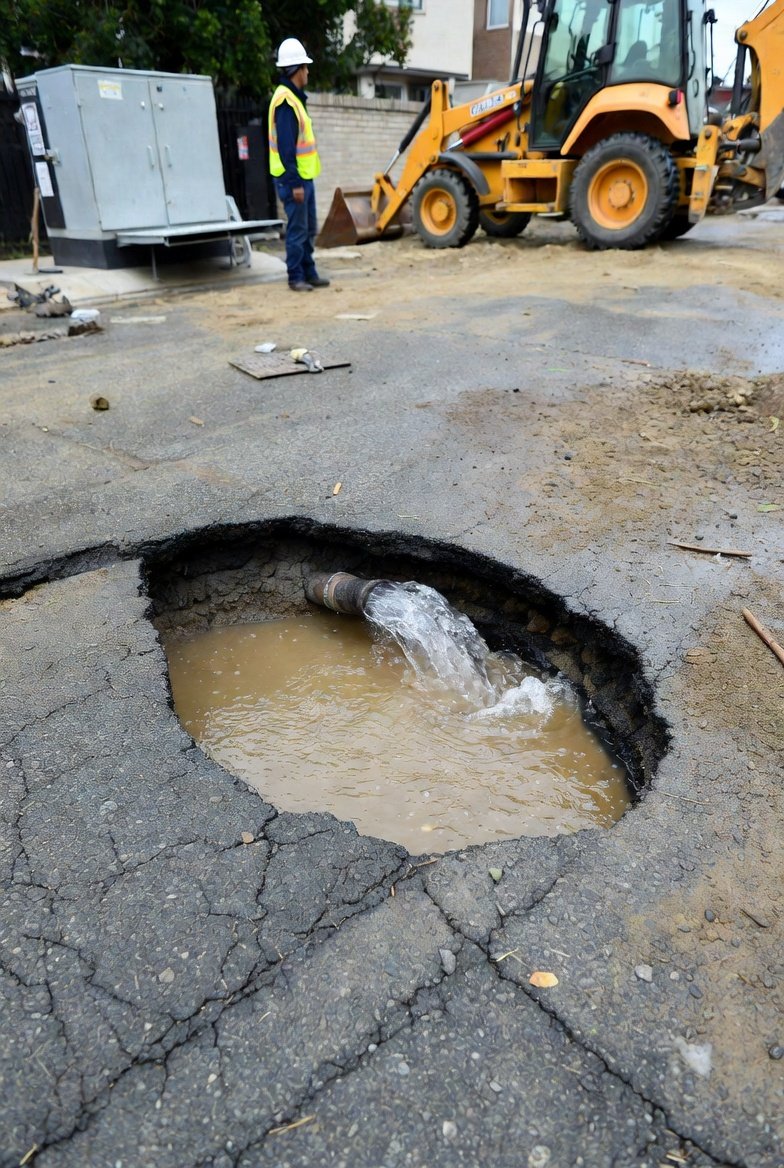
Subsurface cavities develop beneath slabs or driveways.
4️⃣ Surface Settlement or Collapse
Driveway cracking, slab shifting, foundation edge instability.
Freeze–thaw cycles and heavy rainfall accelerate this progression.
Early detection is structural prevention.
🛠️ Underground Water Leak Detection Methods
Detection relies on pressure-signal tracking — not visual guesswork.
Acoustic Leak Detection
- Best for copper or steel lines
- Uses vibration transmitted along pipe walls
- Effective at moderate burial depth
- Less effective on PVC (plastic dampens sound)
Leak Noise Correlation
- Two sensors placed along the line
- Compares sound arrival timing
- Highly accurate for long service lines
- Performance varies with soil conditions and pipe material
Tracer Gas Detection
- Non-toxic gas injected into pipe
- Escapes vertically at rupture
- Strong option for PVC/PEX and under slabs
- Can be less effective in highly porous soil
Thermal Imaging
- Detects temperature differential
- Useful for hot-water lines
- Limited depth capability
🔬 Detection Method Comparison
Method | Best Use | Depth | Material | Purpose |
Meter Test | Confirm presence | Any | Any | Flow confirmation only |
Acoustic | Metal lines | Moderate | Copper/Steel | Locate |
Correlator | Long buried lines | Deep | Metal / some plastic | High precision |
Tracer Gas | PVC/PEX under slab | Moderate | Plastic | High precision |
Thermal | Hot water lines | Shallow | Heated lines | Supplemental |
Professionals often combine acoustic and tracer gas methods for complex cases.
🧠 Why Detection Works (Structural Logic)
When pressurized water escapes:
- It creates vibration
- Vibration travels along pipe walls faster than soil
- Metal transmits signal better than plastic
- Depth reduces clarity
- Saturated soil can dampen acoustic signal
- Nearby utilities, rebar, or background noise can interfere
Under favorable conditions, detection can narrow the failure zone to a small targeted area (often within a foot or less), but precision depends heavily on soil, depth, and material.
🧑🔧 Professional Detection Flow
A typical workflow:
- Confirm leak via meter
- Perform static/dynamic pressure tests
- Listen at valves and fittings
- Narrow zone using acoustic tools
- Use correlator or tracer gas if needed
- Mark target zone
- Excavate a focused area
Typical detection visit: 30–90 minutes under standard conditions.
⚠️ When Detection May Be Inconclusive
Limitations include:
- Extremely deep burial
- Very low-pressure leaks
- Intermittent regulator cycling
- Highly saturated soil
- Mixed pipe systems
In complex cases, professionals may combine techniques or isolate sections.
💰 Cost & Timeline Overview
Detection Costs
Method | Typical Range |
Basic acoustic | $200–$600 |
Correlator or tracer gas | $400–$900 |
Regional labor rates, permit requirements, and site complexity significantly influence totals.
Repair Cost Drivers
Factor | Cost Impact |
Depth greater than 3 ft | +20–40% |
Concrete removal | +$500–$1500 |
Emergency service | +$150–$300 |
Slab penetration repair | $1,500–$5,000+ |
Timeline
Phase | Duration |
Detection | 30–90 minutes |
Excavation | 1–3 hours |
Pipe repair | 1–4 hours |
Surface restoration | 1–2 days |
Driveway or slab restoration may extend beyond one day.
⚖️ DIY vs Professional
DIY | Professional |
Meter confirmation | Pressure mapping |
Surface observation | Acoustic / correlator |
Basic test excavation | Precision excavation |
Basic repair attempt | Multi-method verification |
DIY may be reasonable only for confirming meter movement.
Call a professional if:
- Leak is under slab or driveway
- Pressure loss is significant
- Soil collapse appears
- Responsibility boundary unclear
👉 Schedule service here:
💧 Water Loss & Utility Adjustment
Undetected underground leaks can waste thousands of gallons monthly.
Many utilities offer water-loss adjustment programs if:
- Reported promptly
- Documented with repair confirmation
Early detection reduces both financial and structural risk.
🏠 Insurance & Service Line Coverage
Some policies include optional service-line coverage for:
- Excavation
- Pipe replacement
- Limited landscape restoration
Coverage usually applies to sudden accidental failure — not gradual corrosion.
Verify coverage before excavation.
❓ FAQ
Can I detect underground leaks myself?
You can confirm continuous flow using a water meter test, but precise location usually requires professional equipment.
How much does underground leak detection cost?
Detection typically ranges from $200–$900 depending on method and site complexity.
What happens if I ignore an underground leak?
Soil saturation can lead to void formation, driveway settling, and potential structural damage.
How deep can leaks be detected?
Several feet under favorable conditions, depending on pipe material and soil.
Does pipe material affect detection?
Yes. Copper and steel transmit vibration better than PVC; tracer gas works well on plastic.
Will insurance cover underground pipe leaks?
Coverage depends on policy terms and whether failure was sudden and accidental.