
Water Line Leak Detection: Prevent Structural Damage Before It Escalates
A buried water line leak rarely announces itself loudly.
It begins as:
- Slight pressure loss
- Subtle meter movement
- A damp yard patch
Left unchecked, pressurized water weakens soil compaction, undermines concrete support, and can progress into driveway settlement or slab stress.
Detection exists to stop that progression early — before excavation expands and costs multiply.
This page focuses specifically on private service line detection (meter to house), not interior plumbing.
What “Water Line” Means (Main vs Service vs Interior)
“Water line” may refer to:
- Municipal water main (public system)
- Service line from meter to home (typically homeowner responsibility)
- Interior main feed line
- Branch supply lines
Most residential detection calls involve the private service line between the meter and the home.
If unsure where responsibility lies:
Confirming ownership first prevents unnecessary service charges.
Signs of a Water Line Leak
Look for pattern clusters:
- Continuous water meter movement
- Sudden unexplained water bill increase
- Persistent damp or lush yard area
- Noticeable drop in water pressure
- Soil depressions near foundation or driveway
- Warm slab area (hot supply leak)
Confirm active water loss before scheduling detection:
👉
Risk Escalation Ladder
Water line failures typically progress:
1️⃣ Minor Pressure Loss
2️⃣ Soil Saturation
3️⃣ Subsurface Void Formation
4️⃣ Surface Settlement (driveway cracking, patio shifting, slab stress)
Heavy rainfall or freeze–thaw cycles can accelerate instability.
Detection is risk containment.
Professional Water Line Leak Detection Workflow
Professional detection reduces guesswork and prevents unnecessary excavation.
1️⃣ Static & Dynamic Pressure Testing
- Static test: pressure stability at rest
- Dynamic test: pressure drop during flow
Instability confirms leak severity and whether the issue is service-line related.
2️⃣ Isolation Testing
Plumbers isolate sections to determine whether the leak is:
- On the private service line
- Under slab
- Near the meter
- Inside the home
This step narrows the zone before advanced equipment is used.
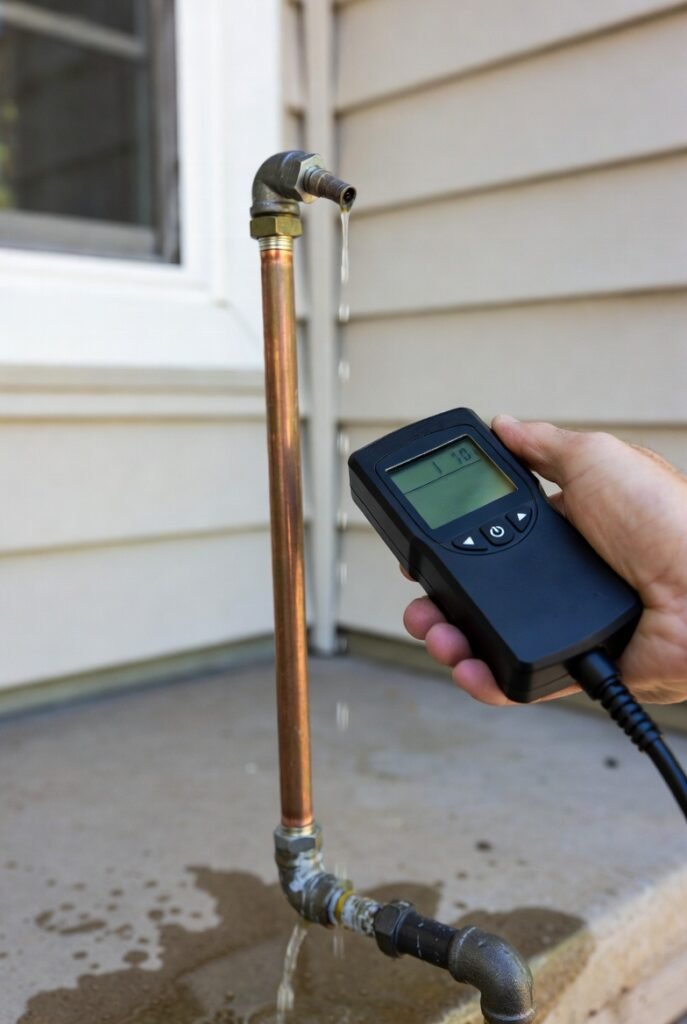
3️⃣ Acoustic Water Pipe Leak Detection
Pressurized water escaping produces vibration.
- Metal pipes transmit vibration well
- Listening devices amplify signal
- Valves and fittings often provide clearer sound access points
Accuracy depends on soil condition, pipe material, and burial depth.
4️⃣ Leak Noise Correlation
Two sensors measure sound arrival differences along the pipe.
Under favorable conditions, correlation can narrow the failure zone to a small targeted excavation area.
Performance varies with:
- Soil saturation
- Background vibration
- Pipe composition
5️⃣ Tracer Gas Detection (Plastic Lines)
When acoustic clarity is limited:
- Non-toxic gas is injected
- Gas escapes vertically at rupture
- Surface sensors detect concentration
Particularly useful under slabs or driveways.
Surface Type & Access Impact
Surface material affects both detection and repair cost.
Surface | Detection Approach | Repair Impact |
Lawn | Acoustic + targeted dig | Lower restoration |
Gravel | Acoustic + correlator | Moderate |
Driveway | Correlator + saw cut | Concrete restoration required |
Slab | Tracer gas + precision core | Structural caution |
Surface type influences excavation planning.
When Detection Is Challenging
Detection becomes more complex when:
- Lines are deeply buried
- Pressure loss is minimal
- Soil is highly saturated
- Leaks are intermittent
- Mixed pipe materials exist
In these cases, professionals may combine methods.
What Happens After Detection
Detection leads to one of three outcomes.
Spot Repair
Small targeted excavation. Replace short pipe section.
Water shutoff typically 1–4 hours.
Partial Line Replacement
Replace damaged segment.
Moderate excavation.
Full Service Line Replacement
Replace entire line from meter to home.
Permit often required.
Inspection may be mandatory.
Surface restoration required.
Trenchless Options
When site conditions allow:
- Pipe bursting
- Directional boring
These reduce surface disruption but depend on soil conditions and access points.
Cost Ladder: Detection to Repair
Detection
Typically $200–$900, depending on equipment and site complexity.
Regional labor rates and permit requirements influence totals.
Repair Ranges (General)
Scenario | Typical Range |
Spot repair | $500–$1,500 |
Partial trench repair | $800–$3,000+ |
Full service line replacement | $2,000–$6,000+ |
Slab penetration repair | $1,500–$5,000+ |
Depth, surface type, emergency scheduling, and restoration scope significantly affect price.
Timeline & Shutoff
Phase | Duration |
Detection | 30–90 minutes |
Excavation | 1–3 hours |
Spot repair | 1–4 hours |
Full replacement | 1–2+ days |
Water is typically shut off during active repair.
DIY vs Professional Boundary
DIY is appropriate for:
- Meter confirmation
- Surface observation
Professional detection is recommended when:
- Leak location is unclear
- Slab or driveway involved
- Soil settlement visible
- Pressure loss significant
Schedule professional evaluation before structural damage escalates:
Insurance & Service Line Coverage
Some homeowner policies include optional service-line riders covering:
- Excavation
- Pipe replacement
- Limited landscaping restoration
Coverage typically applies to sudden accidental failure — not gradual deterioration.
Always confirm coverage before authorizing major excavation.
FAQ
How much does water line leak detection cost?
Typically $200–$900 depending on equipment and complexity.
Can plumbers detect underground water pipe leaks?
Yes. Licensed plumbers use pressure testing, acoustic equipment, correlators, and tracer gas methods.
Can a water main leak be repaired without digging?
In some cases trenchless methods reduce excavation, depending on site conditions.
How long is water shut off during repair?
Spot repairs often require 1–4 hours. Full replacements may require extended shutoff.
What happens if I ignore a water line leak?
Ignoring it can cause soil saturation, void formation, driveway settlement, and rising utility costs.