
Water Leak Test: Confirm a Hidden Leak (Meter Test + Toilet Dye Test + Isolation Steps)
If your water bill suddenly jumps…
If you hear faint running water…
If drywall looks damp but no pipe is visible…
You don’t guess.
You test.
A proper water leak test proves one thing first: is water moving when nobody is using it?
Then it narrows down where the leak likely is.
If water is actively dripping or flooding, stop here and follow emergency steps first:
At a Glance: The Fast Confirmation Path
Do these in order:
2–3 minute meter leak indicator check
10-minute meter re-check
1–2 hour meter reading test
10-minute toilet dye test
Isolation test (inside vs irrigation vs service line)
No guessing. Controlled elimination.
Before You Test: Lock Down Accidental Water Use
Your results are only valid if nothing runs automatically.
Pause or avoid:
Irrigation timers
Ice maker / fridge dispenser
Dishwasher / washing machine
Water softener regeneration cycle
Humidifiers / evaporative coolers
Recirculating hot water pumps
Rule:
No flushing. No faucets. No showers. No hoses.
Even a refrigerator ice maker can invalidate results.
Step 1: 2–3 Minute Water Meter Leak Indicator Test
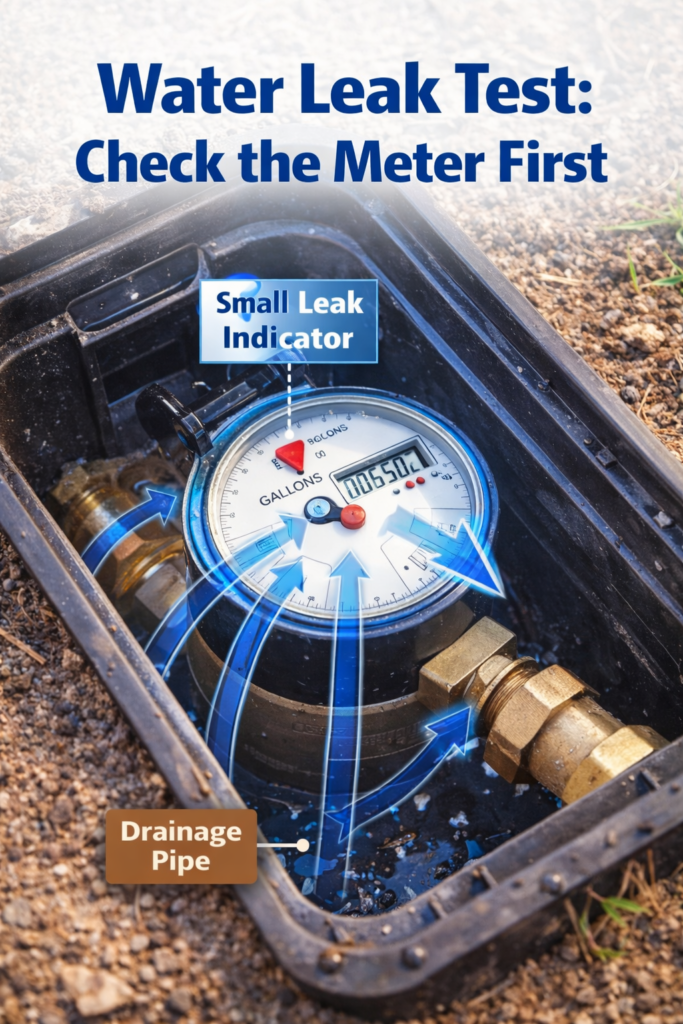
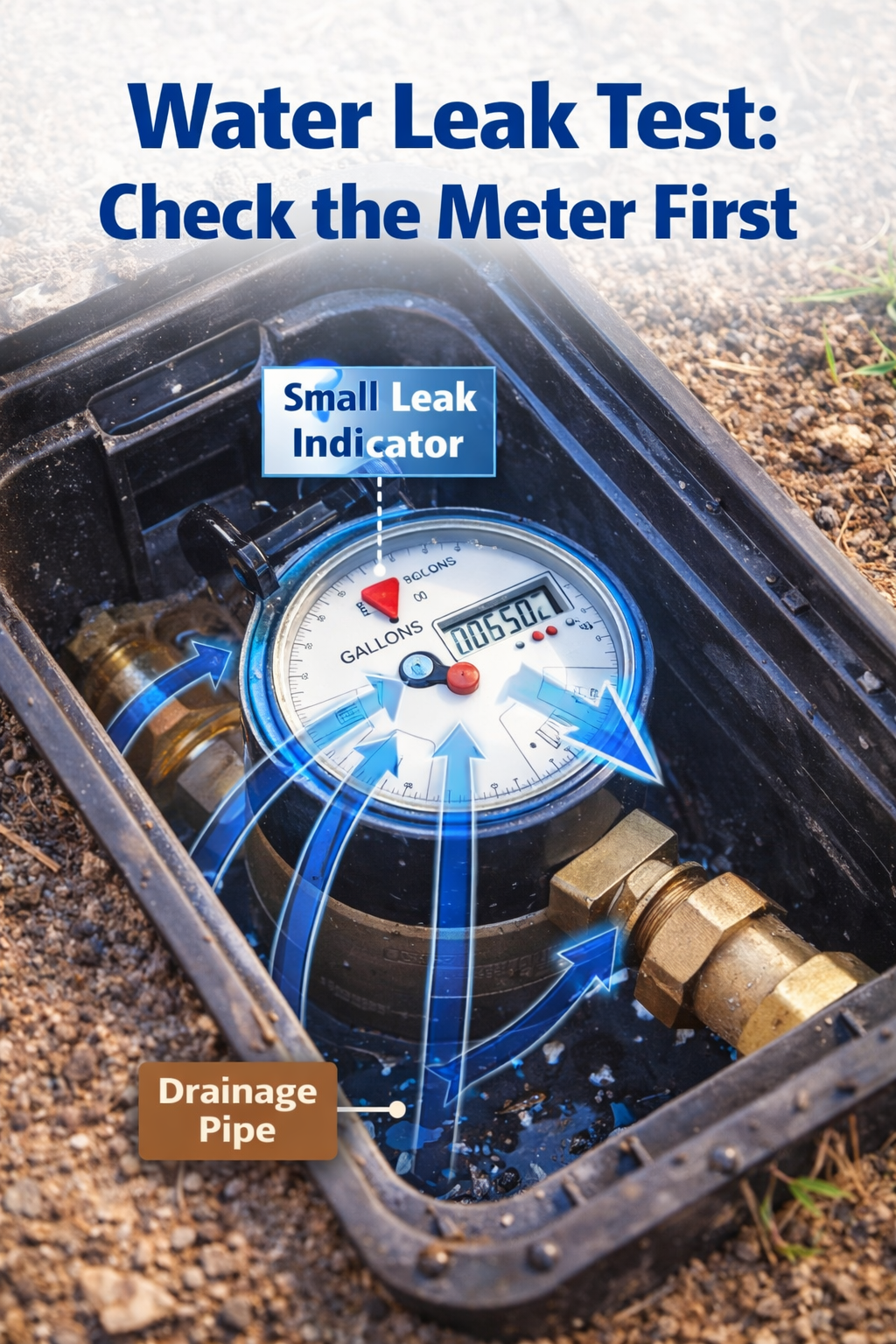
Most residential water meters include a small leak detector dial (often a triangle, star, or tiny spinner).
How to Do It
Confirm zero water use inside and outside.
Locate the small leak indicator.
Watch it continuously for 2–3 minutes.
What It Means
Completely still → likely no active flow
Slow movement → small continuous flow
Steady spin → active leak or fixture running
Even very small motion matters.
Understanding Movement Magnitude (Authority Layer)
Most residential meters measure in:
Cubic feet (CF) — common in many cities
Gallons — less common but possible
1 cubic foot = 7.48 gallons
If your reading increases:
0.1 CF in 10 minutes ≈ 0.75 gallons
That equals ≈ 4.5 gallons per hour
That equals over 100 gallons per day
That is not normal when fixtures are off.
Micro-movement for a second or two after shutoff can happen from pressure settling.
Continuous motion is different.
If You Have a Digital Meter
Some digital meters do not show a triangle dial.
Use this instead:
Take a clear photo of the display.
Wait 10 minutes with zero water use.
Take another photo.
Compare readings carefully.
If numbers changed or a flow icon appears, water moved.
Step 2: 10-Minute Re-Check (Low-Flow Leak Capture)
This catches slow, silent leaks.
- Record the full meter reading (photo recommended).
- Wait exactly 10 minutes.
- Re-check.
Interpretation Ladder
Movement in 10 Minutes | Likely Meaning |
No change | No continuous pressurized leak |
0.01–0.05 CF | Possible slow toilet or valve leak |
0.1 CF or more | Active continuous leak |
Toilets are the most common source of slow movement.
If the reading increases, proceed to isolation.
Step 3: 1–2 Hour Meter Reading Test (Strong Confirmation)
This confirms slow continuous leaks with high confidence.
- Record meter reading (photo + time).
- Wait 1–2 hours with no water use.
- Re-check.
What Results Mean
- Reading increased → confirmed pressurized leak
- No change → no continuous leak during that window
- Still suspicious? → run an overnight test
An overnight test (6–8 hours) is useful for intermittent leaks.
Step 4: 10-Minute Toilet Dye Test (Most Common Silent Leak)
Toilets are the #1 hidden leak source.
Even a small flapper leak can waste hundreds of gallons per day.
How to Do It
- Remove tank lid.
- Add dye tablet or a few drops of food coloring.
- Wait 10–15 minutes.
- Do NOT flush during wait.
If color appears in the bowl → the toilet is leaking.
Flush immediately after.
If your meter confirmed flow, always test toilets before opening walls.
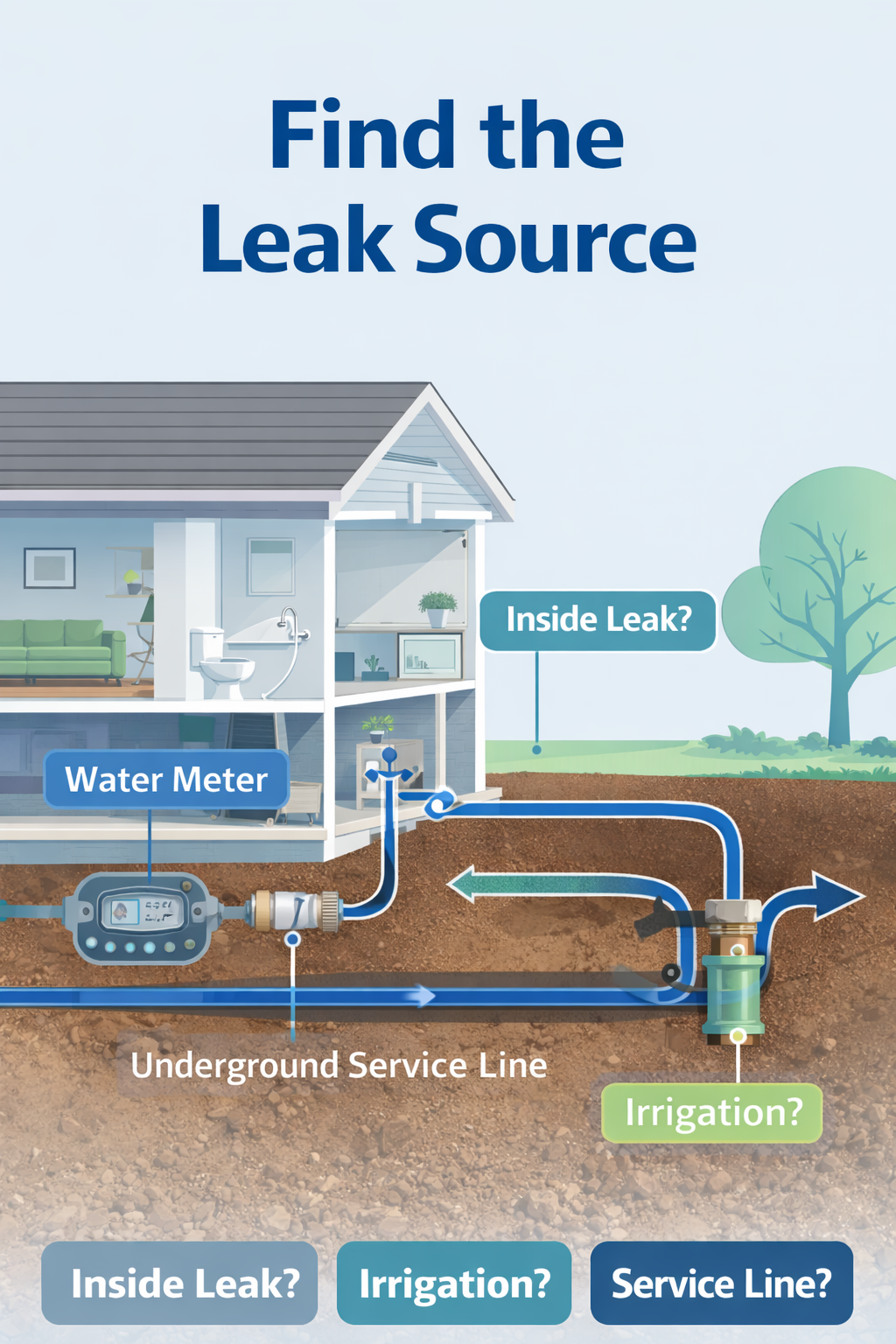
Step 5: Isolation Test (Inside vs Irrigation vs Service Line)
Now you identify location category.
A) Test for Inside-House Leak
- Confirm the meter shows movement.
- Turn off the main shutoff valve to the house.
- Re-check the meter.
If meter stops → leak is inside the house.
Common sources:
- Toilets
- Supply lines
- Water heater
- Under-slab piping
- Appliance lines
If meter continues → move to irrigation test.
B) Test Irrigation (If Present)
- Shut off irrigation supply valve.
- Re-check meter.
If it stops → irrigation leak.
Common irrigation leaks:
- Valve box failures
- Cracked lateral lines
- Stuck zone valves
If it continues → likely service line.
C) Service Line Suspected
If meter still shows movement after house and irrigation shutoff, the leak may be between the meter and the home.
Next step:
water leak detections
Service line leaks often show:
- Wet soil near driveway
- Unexplained ground saturation
- Pressure drop at fixtures
Leak Severity Guide (What the Rate Suggests)
If confirmed:
Gallons per Hour (Approx.) | Likely Scenario |
1–3 GPH | Slow toilet flapper or minor valve leak |
4–10 GPH | Fixture supply line or moderate pipe leak |
10+ GPH | Significant pressurized leak |
Rapid spinning | Burst or major failure |
This is not exact location data — but it helps prioritize urgency.
Common Mistakes During a Water Leak Test
- Forgetting ice makers or softeners
- Testing during irrigation schedule
- Watching meter only a few seconds
- Flushing during wait period
- Not isolating the house main
One mistake can invalidate results.
When the Meter Shows No Movement — But Damage Exists
If meter does not move but you see:
- Ceiling staining
- Damp baseboards
- Warped flooring
Possible causes:
- Intermittent leak
- Drain line leak (non-pressurized — won’t register)
- Old water damage
- HVAC condensate issue
Next diagnostic step:
how-to-find-a-water-leak-in-your-house
or
Results Table: What Your Outcome Means
What You See | Most Likely Meaning | Next Move |
Meter moves with everything off | Active leak | Dye test + isolate |
Meter increases slowly over 1–2 hours | Slow leak | Check toilets first |
Dye appears in bowl | Toilet tank leak | Replace flapper/valve |
Meter moves when house main OFF | Outside house | Check irrigation |
Meter still moves after irrigation OFF | Service line | Underground detection |
No movement but damp signs | Intermittent/drain issue | Professional inspection |
Need clarity on who to call?
water-leak-in-house-who-to-call
When to Stop Testing and Call a Pro
Call for help if:
- You confirm flow but cannot isolate within 1–2 hours
- You suspect a slab leak (warm floor spots, pressure drops)
- Water is near electrical outlets
- Ceiling is sagging or dripping
Start here:
Cost expectations:
Limitations
- A meter test confirms water movement, not exact leak location.
- Intermittent leaks may pass short tests.
- Drain leaks do not register on the meter.
- Do not force shutoff valves.
- Some digital meters round small usage — longer tests may be required.
FAQs
How long should I wait during a water leak test?
Wait 10 minutes for a quick check. For strong confirmation, wait 1–2 hours with no water use. Overnight tests detect intermittent leaks.
Does a small movement on the leak indicator mean I have a leak?
Yes. Continuous movement — even small — can indicate a slow leak.
What is the easiest hidden leak to check first?
Toilets. Use a 10–15 minute dye test.
How can I tell if the leak is in the service line?
Turn off the house main and irrigation. If the meter still shows movement, the leak may be between the meter and the house.