
Water Line Leak Repair: Excavation vs Trenchless (Service Line Guide + Cost Drivers)
A water line leak isn’t a “tighten a fitting” problem.
It’s usually the underground service line—the buried pipe that carries water from the meter area to your home’s entry point. And when that line fails, the bill can jump fast, the yard can saturate, and the repair decision becomes expensive in a hurry.
Here’s the cost reality:
- A small leak can look “minor” above ground
- But the repair may involve locating, excavation, permits, restoration, and sometimes full line replacement
- And the wrong choice (patching an aging line) often creates a second failure a few feet away
This guide explains water line leak repair the way a good contractor would: what the line is, how to confirm it’s leaking, the real boundary between excavate vs trenchless, and when a “repair” is a short delay versus a real fix.
What Counts as a “Water Line” (Service Line)
For most homes, there are two different systems people call “water line”:
- Underground service line (yard line / main supply to the home)
- Interior plumbing pipes (inside walls, under sinks, in basements)
This page is about the underground service line.
If your issue is inside the house (pipes, joints, pinholes), use:
pipe leak repair
Who’s Responsible for the Water Line? (Ownership Boundary)
Responsibility rules vary by location, but the general principle is:
- The utility is typically responsible for the public main and often the meter assembly
- The homeowner is often responsible for the pipe on private property from the boundary/meter area to the home
In many regions, clean-water supply responsibility is shared between water companies and property owners, with private supply pipes commonly falling to the homeowner side.
Practical rule:
- If the leak is after the meter / on your property side, expect homeowner responsibility (confirm with your utility).
How to Confirm You Actually Have a Water Line Leak
Underground leaks hide. You confirm with patterns, not puddles.
Common symptoms:
- Unexplained water bill spike
- New low water pressure
- Wet patch in yard that doesn’t dry
- Sound of water movement when everything is off
- Meter “creep” (meter moves with no fixtures running)
Confirm step-by-step here:
water leak test
If you’re still hunting the general source (inside vs outside), use:
how to find water leak in your house
⚠️ Emergency vs Non-Emergency
Call for urgent service if:
- Water is surfacing rapidly (gushing/boiling up)
- You see sinkholes, driveway settling, sidewalk undermining
- Water is pooling near the foundation
- Pressure drops suddenly across the whole home
If the leak is slow (bill rising, damp yard), you can schedule—but don’t sit on it for weeks. Slow leaks still saturate soil and can erode support over time.
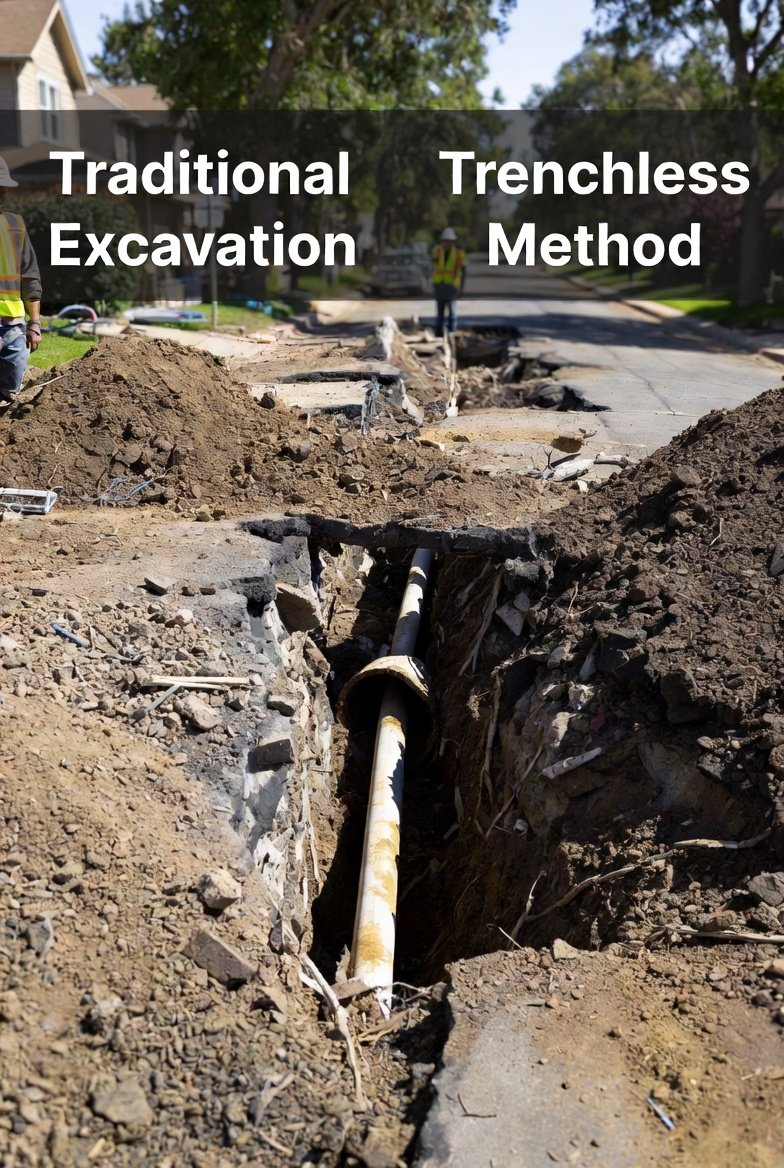
Excavation vs Trenchless: The Core Decision
Most homeowners choose the wrong method because “trenchless” gets marketed like magic.
Trenchless is real—but it’s not always possible, and it’s not always cheaper once you factor site conditions.
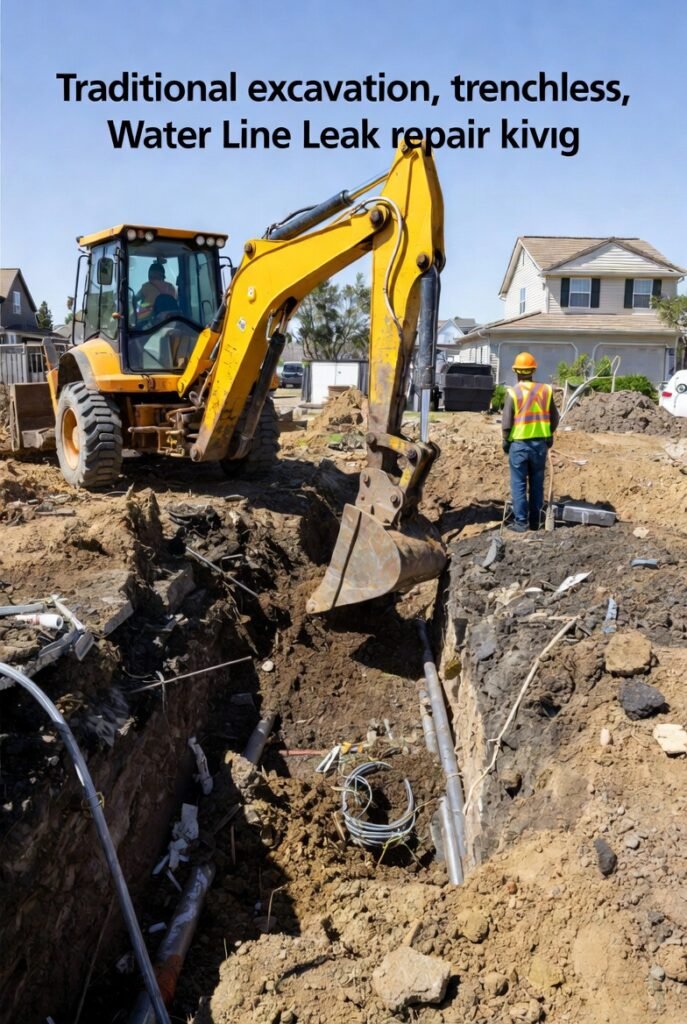
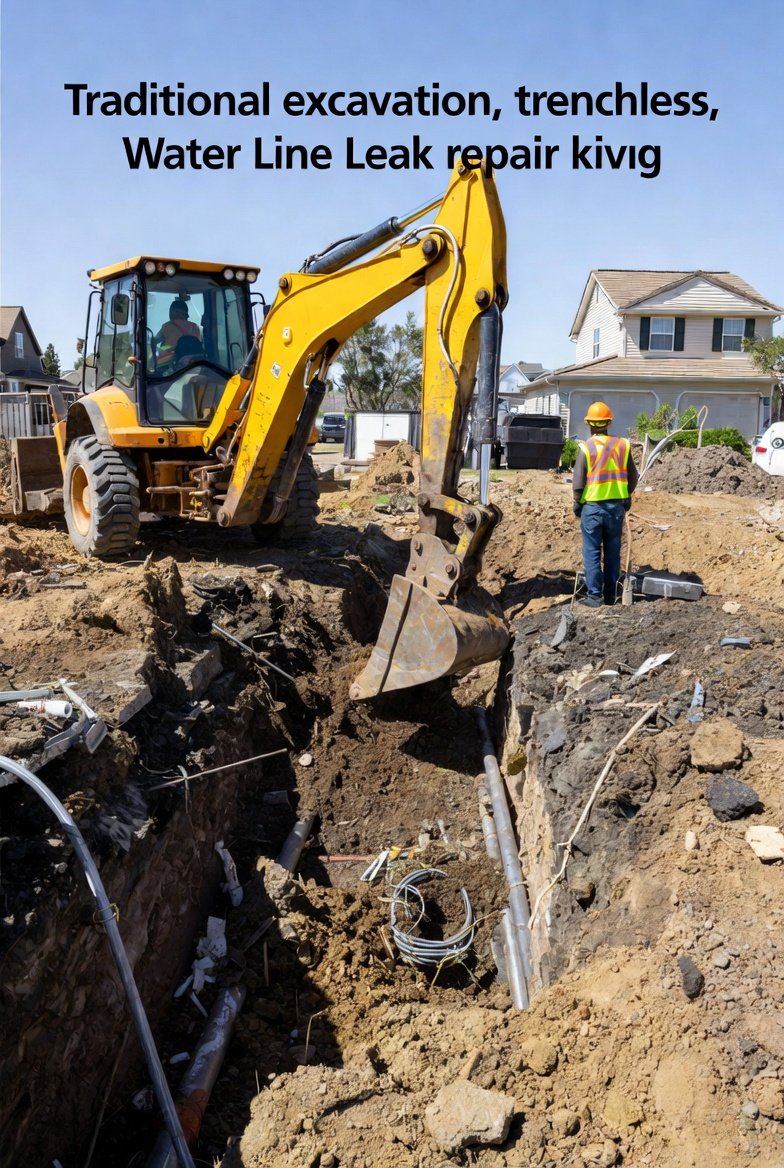
Option A: Excavation Repair (Open Trench)
What it is: digging to expose the line and repair/replace the damaged section.
Best fit:
- The leak is localized and accessible
- Yard access is straightforward
- No long runs under driveways/sidewalks
- You’re okay restoring landscaping
Trade-offs:
- More surface disruption
- Restoration can be a major part of total cost (sod, sprinklers, hardscape)
Option B: Trenchless Replacement (Two Main Types)
Trenchless typically means minimal digging with specialized equipment and access pits.
1) Directional Boring / Pull-Through
A new line is installed through a bored path, often requiring small pits. This approach is often discussed as minimizing landscape damage and is commonly priced by the linear foot in contractor cost guides (ranges vary widely by region).
2) Pipe Bursting
A bursting head is pulled through the old pipe, breaking it while pulling the new pipe into place.
Best fit:
- Long run failures or aging lines
- Multiple weak points (recurring leaks)
- Lines under driveways/sidewalks where trenching is destructive
- You want a long-term replacement rather than a “spot fix”
Limitations to be honest about:
- Soil conditions, obstructions, and site constraints can block trenchless options
- Trenchless still requires pits and access planning
- Some scenarios still need partial excavation
Excavation vs Trenchless Comparison Matrix
Situation | Excavation Usually Wins | Trenchless Usually Wins |
One isolated break in a newer line | ✅ | Sometimes |
Line is older / multiple weak spots | ❌ (repeat failures risk) | ✅ |
Under driveway/sidewalk/hardscape | ❌ | ✅ |
You need visual inspection of the full run | ✅ | ❌ |
You want minimal landscape disruption | ❌ | ✅ |
Pipe material is failing system-wide | ❌ | ✅ (replace) |
Pipe bursting is commonly positioned as a trenchless replacement method that reduces excavation compared with open-cut approaches, but feasibility depends on conditions.
Repair vs Full Replacement: The Real Boundary
Here’s the logic contractors use (and sales pages rarely explain):
Spot Repair makes sense when
- The line is relatively new
- The failure is clearly isolated
- The remaining pipe shows no broader deterioration pattern
- The leak is in a location that’s easy to access and restore
Full Replacement becomes smarter when
- The line is older (especially older materials with corrosion history)
- You’ve had more than one leak or weak section
- The leak is under hardscape and you’ll pay restoration twice
- Your repair quote is ~60–70% of replacement cost (common tipping point)
Cost Reality: Typical Ranges + What Drives Them
Online cost references commonly cite per-foot pricing and broad totals for main/service line work, with trenchless and trenched methods differing by approach and site factors.
A practical way to think about cost is drivers, not “one number.”
Cost Driver Table
Cost Driver | Why It Changes Price |
Linear feet of line | More distance = more pipe + more labor/equipment time |
Depth / frost line | Deeper lines require more labor and sometimes shoring |
Hardscape crossings | Driveways/sidewalks/pavers add cutting + restoration |
Soil type | Rock/clay/wet soil slows work and increases equipment needs |
Permits + inspections | Many areas require inspection before backfill |
Entry point complexity | Tight crawlspace, basement penetration, or manifold complexity |
Restoration scope | Landscaping, irrigation, concrete, and grading can rival plumbing cost |
Typical cost bands (very general)
- Localized repair (excavation): often lower total, but restoration can swing it
- Full replacement (trench or trenchless): higher base cost, often better long-term reliability
If you want the broader “repair includes drying + verification” framework (important if saturation occurred), use:
water leak repair
What Pros Actually Do (Professional Workflow Transparency)
A legit water line repair crew usually follows a sequence like this:
- Confirm the leak (meter behavior + isolation)
- Locate the line path and identify likely failure zone
- Choose method (spot dig vs replace vs trenchless)
- Expose/access (trench section or access pits)
- Replace/repair with approved materials
- Pressure test before closing
- Disinfect/chlorinate and flush where required by local procedures/specs (common in municipal work and many professional replacement workflows)
- Inspection (where permits require)
- Backfill + compaction
- Restore surface (rough grade → final landscape/hardscape repair)
That sequence matters because many failures happen when people skip verification and restoration best practices.
Permits, Inspection, and Code Reality
Many jurisdictions require:
- A plumbing permit
- Inspection before backfill
- Approved material type and minimum depth
Skipping permits can create resale issues and can force expensive rework later.
Hard Stop Conditions
Call for service (do not DIY) if:
- You suspect an underground service line leak
- The leak is under concrete/driveway/sidewalk
- You see sinking ground or washout
- You can’t isolate whether it’s utility side vs private side
- You need excavation or trenchless equipment to access the line
Service pathway:
water leak repair services
If you need the broader DIY-safe basics for interior leaks (different topic), use:
Limitations
This page is a repair decision guide. It does not replace:
- Utility coordination and local responsibility confirmation
- Soil/engineering assessment for severe washout
- Foundation assessment if erosion occurred near the home
FAQs
Is a water line leak an emergency?
It can be. Rapid surfacing water, sinkholes, sudden pressure loss, or undermining near the foundation should be treated as urgent.
What’s the difference between excavation repair and trenchless repair?
Excavation exposes the pipe by digging. Trenchless methods use pits and equipment to replace the line with less surface disruption, often via directional boring or pipe bursting.
Is trenchless water line replacement always possible?
No. Soil conditions, obstructions, existing pipe condition, and site layout can limit trenchless feasibility.
When should I replace the whole service line instead of repairing one spot?
When the line is older, has multiple weak sections, or the repair cost is close to replacement cost (a common tipping point is roughly 60–70%).
Who usually pays for the leak repair—homeowner or utility?
It depends on location, but responsibility is often shared between utility and property owner, with private supply pipes commonly on the homeowner side (confirm with your local utility).
How do I confirm the leak is in the yard line and not inside the house?
Start with meter-based confirmation and isolation steps:
How long does water line repair take?
Many spot repairs and replacements are commonly completed within 1–2 days, but site conditions, permits, and restoration can extend timelines.