
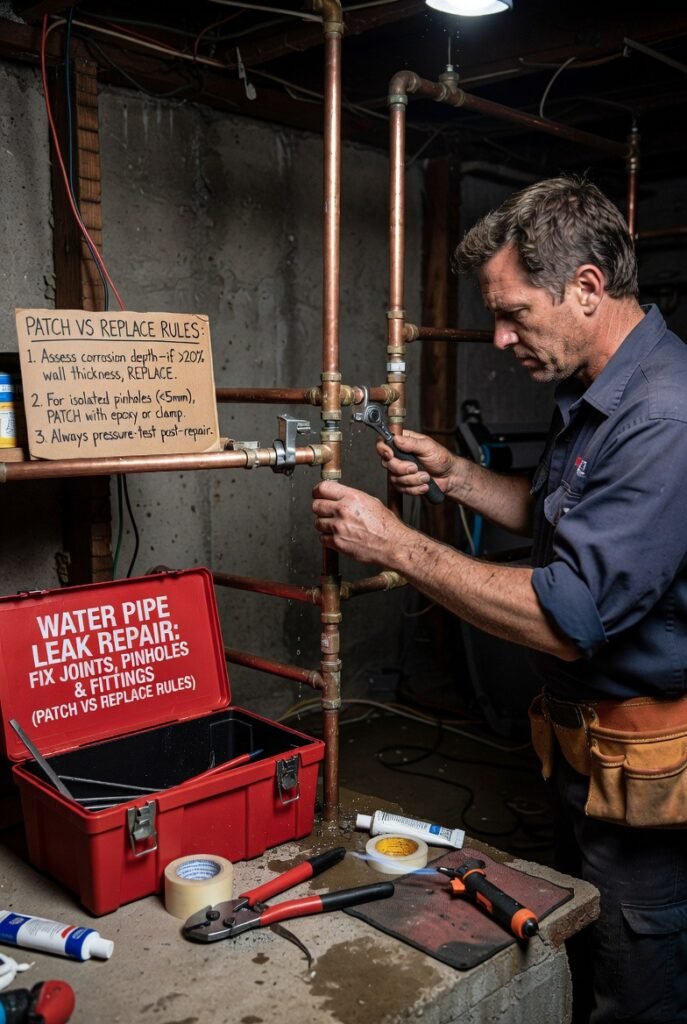
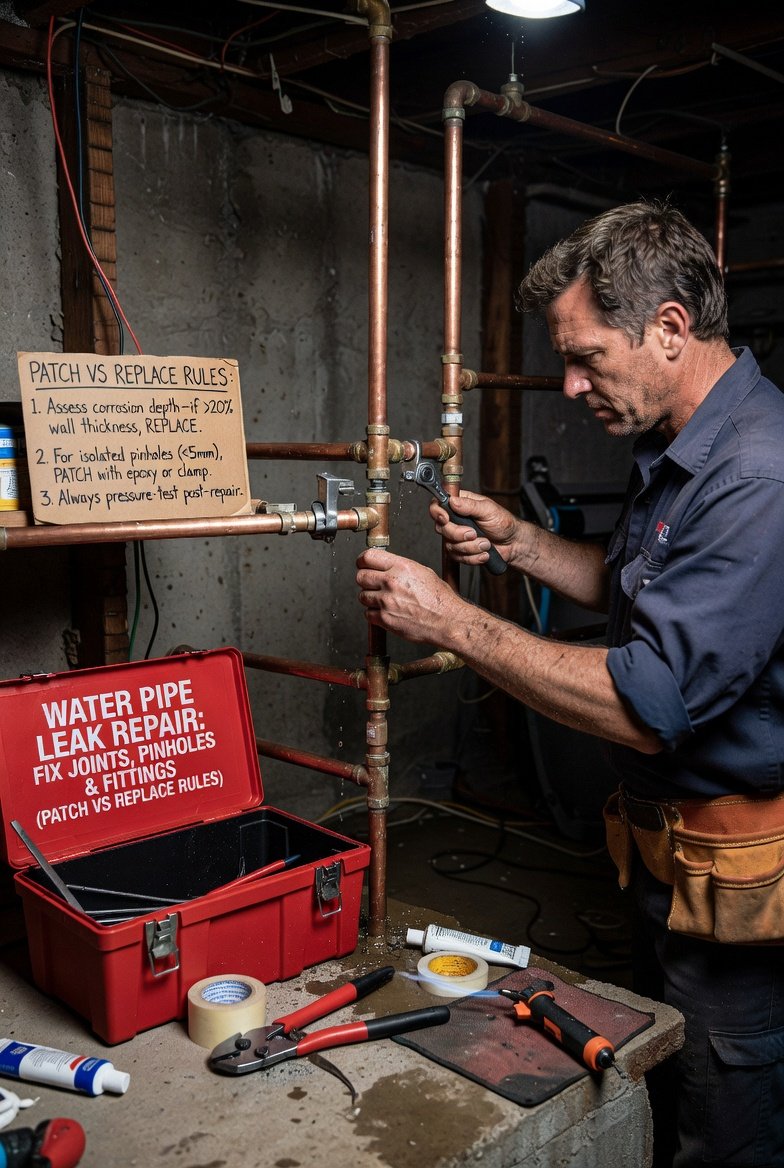
Water Pipe Leak Repair: Fix Joints, Pinholes & Fittings (Patch vs Replace Rules)
A leaking water pipe puts you at a fork in the road:
- Patch it to stop water right now
- Replace the failing section so it doesn’t come back
- Stop DIY and call a plumber because the risk is bigger than the leak
Most pipe leak “repairs” fail for one reason: the method didn’t match the leak.
A clamp on a corroded pipe. Epoxy on a wet surface. Overtightening a joint until the fitting deforms. Or sealing a wall cavity before it’s dry.
This guide shows you how to repair a leaking water pipe the right way—by leak type (joint leaks, pinholes, fitting/valve leaks) and by pipe material (copper, PEX, CPVC, galvanized)—with clear boundaries on when patching is acceptable and when replacement is the only smart move.
Step 1: Shut Off Water, Relieve Pressure, Make It Safe
Before any pipe repair:
- Shut off water at the closest valve (or main if you can’t isolate it)
- Open a faucet to relieve pressure and drain the line
- Dry the area so you can see the leak clearly
- If water is near outlets, lights, ceiling fixtures, or a panel wall, shut off power at the breaker first
If you’re unsure whether the leak is active or residual, confirm first:
water leak test
If you haven’t located the exact pipe section yet:
water leak in house
Quick ID: What Kind of Pipe Do You Have? (Fast Material Guide)
If you repair the wrong way for the material, you create more damage.
- Copper: rigid metal, reddish-brown; soldered joints or compression fittings
- PEX: flexible plastic tubing (often red/blue/white); crimp or clamp rings at fittings
- CPVC: rigid plastic (often off-white/beige); glued joints (solvent-welded)
- Galvanized steel: rigid metal, gray; threaded joints; often older homes; corrosion common
If your pipe is brittle, heavily corroded, or inside a wall/ceiling cavity, treat this as a “call pro” situation.
Leak Behavior: Weep vs Drip vs Spray (Urgency Classifier)
Leak Behavior | What It Usually Means | Best First Move |
Weeping / damp seam | Minor seep at a joint or valve packing | Dry + inspect + reset joint |
Steady drip | Seal failure or small opening | Replace fitting/section or clamp temporarily |
Spray / stream | Split pipe or failed joint under pressure | Main shutoff + immediate repair or plumber |
Spray leaks are not a “tape and wait” problem. They’re a shutoff-and-fix problem.
Patch vs Replace vs Call a Plumber (Decision Matrix)
Leak Situation | Patch OK (Temporary) | Replace Section | Call a Plumber Now |
Single tiny pinhole on otherwise solid pipe | Sometimes | Often recommended | If corrosion or repeats |
Leak at compression nut/threaded joint | Sometimes | If fitting is damaged | If it won’t reseal |
Split/bulge/crack in pipe | No | Yes | Yes |
Leak inside wall/ceiling cavity | No | Usually | Yes |
Heavy corrosion/flaking | No | Yes | Yes |
Water near electrical or ceiling sag | No | No | Immediate |
If the leak presents as a ceiling stain or drip, treat it as a ceiling system issue, not just a pipe issue:
ceiling water leak
What’s Actually Leaking? (Three Common Pipe Leak Types)
1) Joint Leak
Where two parts connect:
- threaded joints
- compression fittings
- soldered copper joints
- push-to-connect couplings
- PEX crimps/clamps
Joint leaks are often fixable if the pipe itself is healthy.
2) Pinhole Leak
A tiny hole through the pipe wall (common in older copper and corroded metal).
Pinhole leaks are rarely “one-off.” One pinhole can be a warning sign.
3) Fitting or Valve Body Leak
Sometimes the leak is not the pipe—it’s the valve body or a cracked fitting (especially after freezing or overtightening).
Tool Ladder: Temporary Stop vs True Repair
Temporary Stop Tools
- Pipe repair clamp
- Self-fusing silicone tape
- Epoxy putty (only on clean, dry surfaces)
True Repair Tools
- Replacement coupling + short pipe section
- Slip/repair coupling (where appropriate)
- PEX crimp or clamp tool (for PEX)
- CPVC primer/cement (for CPVC)
- Adjustable wrenches + proper cutters
Temporary tools are for buying time, not for ignoring failing pipe.
How to Repair a Leaking Water Pipe by Scenario
Scenario A: Leaking Compression Fitting or Threaded Joint
Best when: leak is at a nut, thread, or connection and the pipe wall is intact.
Reset Sequence (Do This Instead of “Tighten Forever”)
- Shut off water and relieve pressure
- Dry the joint completely
- Tighten gently (¼ turn) and test
- If still leaking: disassemble
- Inspect for cracks, deformation, cross-threading, or damaged sealing surfaces
- Clean and re-seat correctly
- Reassemble and test under pressure
Replace Instead of Keep-Tightening When
- The nut bottoms out and still leaks
- The fitting is cracked or distorted
- The joint weeps again after reseating
- The pipe end is out-of-round or damaged
Scenario B: Pinhole Leak in Copper Pipe
Decision fork: stop it now vs fix it for good.
Temporary Patch (Buy Time)
Use a clamp or a short-term seal only when:
- It’s a single pinhole
- The pipe surface is solid (not flaking or heavily corroded)
- You plan a permanent repair soon
Permanent Repair (Recommended)
- Shut off water and drain the line
- Mark the leak zone
- Cut out the damaged section
- Install a proper repair coupling (method depends on system and skill)
- Turn water on slowly and verify
Replace the Run (or Call a Plumber) When
- Multiple pinholes appear near each other
- Corrosion is widespread
- The pipe wall looks thin, pitted, or chalky
Scenario C: PEX Pipe Leak Repair
PEX leaks are usually:
- a bad crimp/clamp
- a damaged pipe end
- a split from freezing or abrasion
Repair Steps
- Cut out the damaged PEX section cleanly
- Ensure a clean, square cut
- Use the correct fitting for your system (crimp or clamp)
- Make the connection with proper ring placement and tool compression
- Pressurize slowly and re-check
Replace Instead of Patch When
- The PEX is kinked at the leak
- The leak is at a stressed bend or unsupported span
- The pipe shows abrasion or heat damage
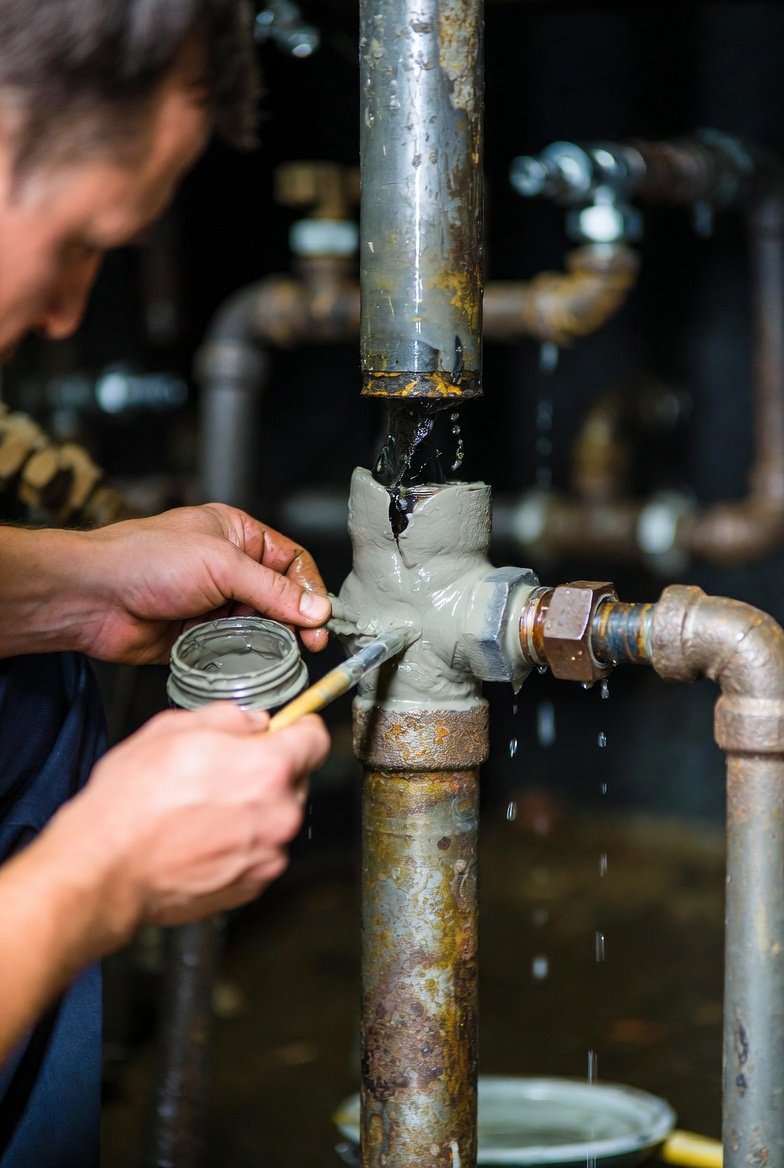
Scenario D: CPVC Pipe Leak Repair (DIY Boundary Is Tighter Here)
CPVC can be brittle, and poor prep can cause cracks that show up later.
DIY Reality Check
Only attempt CPVC repair if:
- You can cut cleanly and align joints without forcing
- You understand primer/cement application and cure timing
- The CPVC isn’t brittle or cracking when touched
Call a Pro If
- The CPVC cracks as you handle it
- The leak is near a manifold, high-stress joint, or valve cluster
- You cannot hold alignment without bending or force
Scenario E: Galvanized or Heavily Corroded Pipe Leak
If you see rust, flaking, or heavy corrosion:
- Clamps may fail because the surface can’t seal
- “Patch-and-pray” often creates repeat leaks nearby
Best decision is a replacement strategy (section or larger run), usually professional.
What NOT to Do (Common Leak Repair Traps)
- Don’t use duct tape as a “repair”
- Don’t overtighten a joint repeatedly (you can deform it)
- Don’t epoxy a pipe that’s still wet or actively spraying
- Don’t clamp over heavy corrosion and assume it’s safe
- Don’t close a wall or ceiling cavity while it’s still damp
- Don’t treat ceiling symptoms as a “pipe-only” problem
If the leak affected a ceiling cavity, use the correct ceiling sequencing:
Hard Stop Conditions (Do Not DIY Beyond This)
Stop and call a professional if:
- The leak is inside a wall or ceiling cavity
- Ceiling drywall is soft, bulging, or sagging
- Water is near electrical fixtures
- You can’t isolate the exact pipe section
- The pipe is corroded or failing in multiple points
- You tried one correct method and it still leaks
Service pathway:
For the bigger picture of what “repair” includes beyond stopping water flow:
water leak repair
Post-Repair Verification Checklist (Pipe-Specific)
After any pipe leak repair:
- Turn water on slowly (avoid pressure shock)
- Watch the repair point for 10 minutes
- Recheck after 1 hour
- Recheck again after 24 hours
- Look for moisture trails on nearby framing, insulation, or drywall edges
If the leak occurred in a wall or ceiling cavity, don’t rebuild until you’re confident the area isn’t staying damp. If you see new staining or softness, treat it as a ceiling system issue:
ceiling water leak
If you need the broader DIY-safe overview (beyond pipe repairs):
how to repair water leak
Limitations
This page is pipe-specific. It does not replace:
- professional leak detection for slab or concealed systems
- restoration steps when insulation, drywall, or framing is saturated
- electrical safety checks when water contacts fixtures or wiring zones
FAQs
Can I repair a leaking pipe without replacing it?
Sometimes. A clamp or temporary seal can stop a small localized leak on a solid pipe, but corrosion, cracks, or repeat leaks usually require section replacement.
Is a pipe repair clamp a permanent fix?
It’s best treated as temporary unless the pipe is in excellent condition and the leak is truly isolated.
What causes pinhole leaks in copper pipes?
Pinhole leaks often relate to localized pipe thinning and corrosion patterns. If pinholes repeat, the system may need broader evaluation or replacement planning.
Can I use epoxy putty on a leaking pipe?
Epoxy putty can help on a small leak when the surface is properly prepared and dry, but it is typically a stopgap rather than a permanent pipe replacement.
Why does a fitting leak even after tightening?
The sealing surface may be damaged, the compression ring may be deformed, threads may be compromised, or the pipe end may not be seated correctly.
Should I cut open drywall to repair a pipe leak?
Concealed leaks often require access, but you should confirm the source first and avoid sealing wet cavities without drying verification.
When should I call a plumber for a pipe leak?
Immediately if the leak is concealed, the pipe is corroded, water is near electrical, the ceiling is soft or sagging, or your repair attempt does not hold under pressure.